
On this page 10
Key takeaways
- Every trading bot has five layers: data, features and signals, a decision engine, execution via API, and risk controls.
- The decision engine is fixed rules in most bots, a trained ML model in a few, and a language model in AI agents.
- Grid and DCA bots are rule-based. Useful, predictable, and not AI, whatever the sales page says.
- Overfitting is the main way ML bots fail: brilliant backtests, poor live results.
- Ask for specifics: which model, trained on what, retrained how often. Vague answers usually mean AI-washing.
How does an AI crypto trading bot work? Strip away the marketing and every bot, smart or simple, is the same pipeline: it reads market data, turns it into signals, decides what to do, sends orders to an exchange and checks those orders against limits. The "AI" part, when it exists, lives in one box of that pipeline: the decision engine. Knowing where that box is, and what is inside it, is the fastest way to judge any bot you are offered.
This guide walks through each layer, compares machine-learning bots with grid and DCA bots, explains training and overfitting without the maths, shows how language-model agents change the picture, and ends with a checklist for spotting AI-washing.
What is an AI crypto trading bot?
A trading bot is software that places orders on your behalf according to logic you or the vendor defined. It is an AI crypto trading bot only when some part of that logic is learned from data or produced by a model, rather than written as fixed rules. That sounds like a fine distinction, but it changes everything about how the bot behaves: rules do the same thing every time, learned models change their behaviour as data changes, and language models can produce different decisions from the same input.
What is AI crypto trading, then, in practice? Across the 55+ tools we track, we see five levels: real machine learning, LLM agents that act, LLM assistants that advise, rule-based bots with an AI layer on top, and pure rule-based bots sold as AI. The AI crypto tools directory labels every product on that scale.
So how does an AI crypto trading bot work differently from an ordinary one? Mostly it does not. The data, execution and risk plumbing are the same; only the decision engine changes, which is why the next two sections matter more than any feature list.
How does an AI crypto trading bot work? The five layers
Think of the bot as a stack. Data flows up, orders flow out, and the risk layer can veto anything.
Data layer
Prices, order books, trades and funding rates from the exchange, usually by API or websocket. Better bots add on-chain flows, news or social sentiment from providers such as Santiment or LunarCrush.
Features and signals
Raw data becomes inputs: moving averages, RSI, volatility, volume spikes, funding changes, sentiment scores. In ML bots these are called features; in rule bots, indicators.
Decision engine
Fixed rules ("buy when RSI is below 30"), a trained model that outputs a probability or target, or a language model that reads context and proposes an action.
Execution via API
The bot sends orders to the exchange using API keys you created. It handles order types, partial fills, retries and fees. Trade-only permission is all it should ever have.
Risk management
Position sizing, stop-losses, maximum exposure, daily loss caps and kill switches. In a well-built bot this layer is deterministic and sits outside the decision engine.
Why the layers matter to you
Most failures happen outside the decision engine. Bad data (a stale price feed, a missing candle) produces bad signals. Execution problems (slippage, rate limits, an exchange outage) turn a winning signal into a losing trade. And a weak risk layer is what turns a bad week into an empty account. When you compare bots, ask about every layer, not only the "AI".
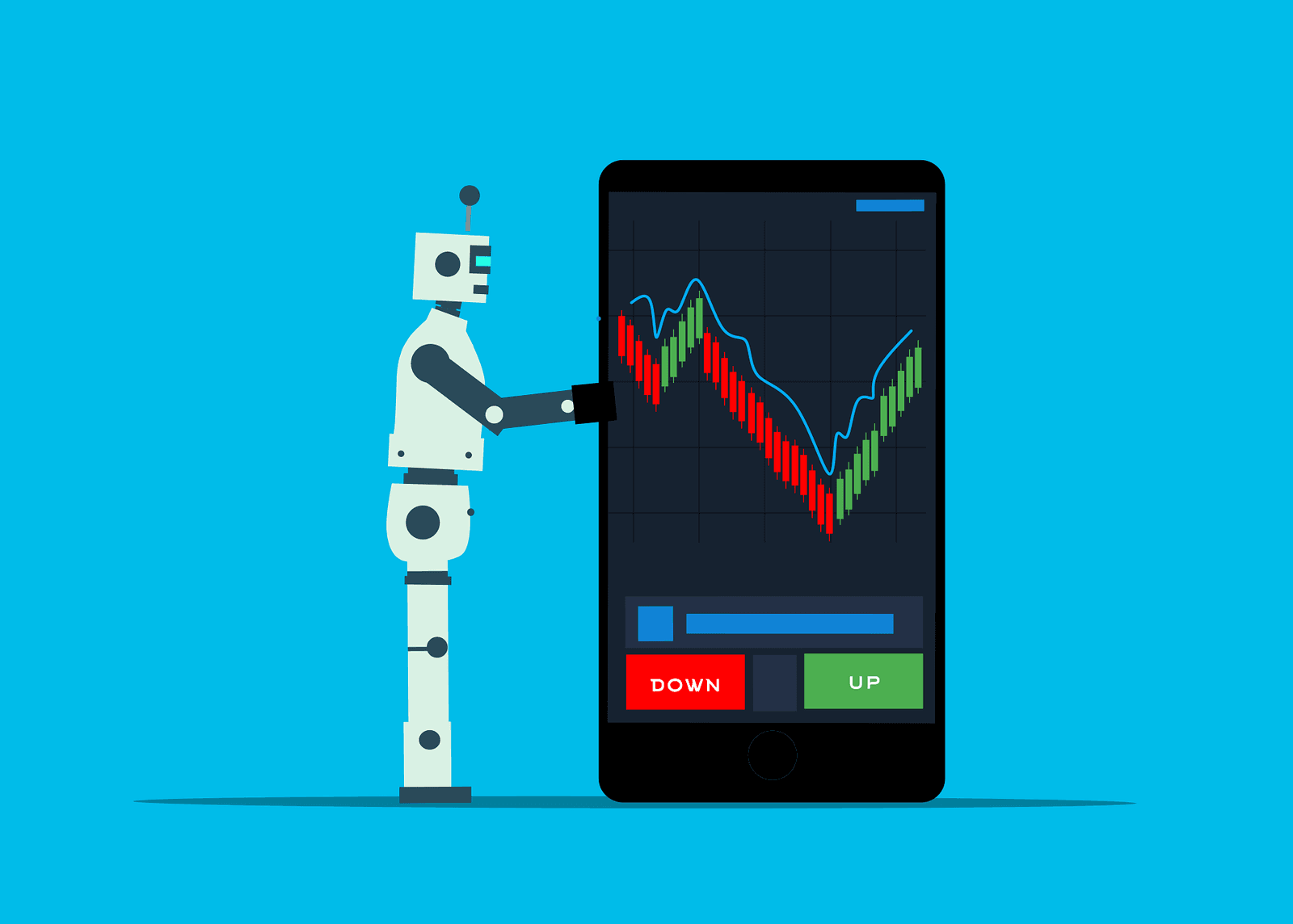
Three kinds of decision engine: rules, machine learning, language models
Rules
Fixed if-then logic. Grid bots, DCA bots, indicator bots and TradingView signal bots all fall here. They are cheap, fast, transparent and easy to backtest. Their weakness is that they keep doing the same thing when the market changes; a grid bot in a strong trend keeps selling early or buying into a fall.
Machine learning
A model is trained on historical features to predict something, such as the return over the next few hours or the probability that price rises. The bot then trades on the prediction. Freqtrade's FreqAI module is the clearest documented example: it trains LightGBM, CatBoost, PyTorch and reinforcement-learning models and retrains them periodically during live and dry runs. It was described in a peer-reviewed paper in the Journal of Open Source Software in 2022. Commercial bots rarely document anything this specific.
Language models
An LLM reads text and numbers (prices, news, on-chain summaries) and outputs a decision in words or structured form. It can weigh context a rule cannot, such as "the token unlock is tomorrow". It is also slower, more expensive per decision and less consistent. LLMs show up in two ways: as assistants that help you configure rule bots, and as agents that make and execute decisions themselves.
AI crypto trading bot vs grid bot
This is the comparison sales pages blur most. A grid or DCA bot is not a weaker AI bot; it is a different tool with different strengths.
| Grid bot | DCA bot | ML bot | LLM agent | |
|---|---|---|---|---|
| Decision logic | Fixed price grid | Scheduled or safety-order buys | Trained model predicts | Model reasons over context |
| Learns from data? | No | No | Yes, if retrained | Not between sessions |
| Predictable? | High | High | Medium | Low |
| Best market | Sideways chop | Long-term accumulation | Depends on features | News and narrative shifts |
| Main risk | Trend breaks the range | Buying all the way down | Overfitting | Wrong or erratic actions |
| Example | Pionex, Bitsgapbitsgap.com ↗ | 3Commas, Bitsgap3commas.io ↗ | Freqtrade FreqAIfreqtrade.io ↗ | Nansen AInansen.ai ↗ |
Where do "AI grid bots" fit? Usually as a rule-based grid with an AI layer that suggests the price range or picks a bot portfolio. Bitsgap's AI Assistant, for instance, "analyzes market trends and deploys a personalized portfolio of trading bots" based on your risk tolerance, but the company does not publish its method. Cryptohopper's AI features, which rank strategies by backtest performance, only come with its $129 Hero plan. Both are helpful, neither turns the grid into a learning system.
If you want to go deeper on the rule-based side, our guides to crypto grid trading bots and DCA bots cover settings and pairs.
What training and overfitting actually mean
Training a trading model means showing it many examples of past features (say, the last 24 hours of returns, volume and funding) together with what happened next, and letting it find the relationship. A trained model is just a function that maps today's features to a prediction.
The trap is that markets are noisy. Given enough parameters, a model will find patterns in noise that never repeat. That is overfitting, and it produces the classic story: a backtest with a smooth equity curve, followed by weeks of live losses. The same thing happens without ML when you optimise a rule bot too hard; running hundreds of parameter combinations and picking the best is overfitting by brute force.
How careful builders reduce it
- Out-of-sample testing: train on one period, test on a later period the model never saw.
- Walk-forward retraining: retrain on a rolling window and test on the next slice, repeatedly. FreqAI automates this.
- Fewer, sensible features: every extra input is another chance to fit noise.
- Fees and slippage in the backtest: high-frequency strategies often look profitable only before costs.
- Paper trading: weeks of forward testing on live prices before real money.
How LLM agents differ from bots
An AI agent is a language model given tools: a data feed, an exchange API or a wallet, and permission to act. Instead of executing rules, it reads the situation, plans and places orders. Nansen AI, for example, answers wallet and token questions and can execute spot or perps trades in the same conversation. Exchanges have added agent rails too: Binance AI Pro connects AI models to a no-withdrawal sub-account, OKX's Agent Trade Kit requires approval for write actions, and Kraken's CLI exposes its MCP server read-only by default.
Three differences matter in practice. Agents are non-deterministic: the same prompt and data can produce different trades. They are context-sensitive: a phrase in a news article or a manipulated post can change their behaviour, which is why prompt injection is a real risk. And they are hard to backtest, because replaying history through a model is slow, costly and contaminated by what the model already knows about that history.
The best evidence on LLMs trading so far is Alpha Arena, where research lab Nof1 gave models real money and identical instructions. In Season 1.5, which ended on 3 December 2025, the winning model made 12.11% in aggregate, yet only 6 of 32 model-and-mode runs finished positive. Our AI crypto trading agents guide covers the platforms; the Alpha Arena results page covers the data.
Bots execute; your funds still need a trustworthy home
Whatever sits in the decision layer, the money ends up on an exchange. CEX.IO has operated since 2013, is a FinCEN-registered MSB with money transmitter licences in 39 US states plus DC, and is FCA-registered in the UK. It does not offer AI bots, which suits a setup where research and automation tools stay separate from where you buy and hold.
Registrations checked October 2026 on the company's legal pages. Availability depends on your country; crypto is high-risk.
- Since 2013One of the longest-running crypto exchanges still operating
source - 39 US states + DCFinCEN-registered MSB with state money transmitter licences (NMLS 1804170)
source - FCA-registeredUK cryptoasset business under the MLRs, FRN 1007192
source - PCI DSS Level 1Card-payment security standard, 2026 certificate published
source
How to spot AI-washing in a trading bot
AI-washing is the practice of claiming AI capabilities you do not have. It is not only a crypto problem, and regulators have started to act on it.
On 18 March 2024 the SEC settled charges against two investment advisers. Delphia (USA) had claimed in filings and marketing that it used AI and machine learning on client data to predict which companies would succeed, and paid $225,000. Global Predictions had called itself the "first regulated AI financial advisor" offering "expert AI-driven forecasts", and paid $175,000. The SEC found neither had the capabilities claimed. Chair Gary Gensler put it plainly: "Such AI washing hurts investors."
Crypto bot marketing is rarely that formal, but the pattern is the same. The warning signs:
- "Advanced AI" with no model named, no training data described and no retraining schedule.
- Return screenshots instead of methodology: monthly percentages without drawdowns, fees or the test period.
- AI that does not change anything: the bot is a grid or DCA bot and the "AI" is a settings suggestion.
- Guaranteed or fixed returns, which the CFTC calls a hallmark of fraud.
- Deposits to the platform itself rather than an API connection to a regulated exchange you control.
The last two cross from marketing into scam territory. Our AI crypto trading scams guide lists the platforms regulators have named.
Checklist before you trust an AI trading bot
About the AI
- Which layer is AI: signals, decisions or only the assistant?
- Which model type, trained on what data?
- How often is it retrained, and is that documented?
- Out-of-sample results with drawdown and fees?
- Can you run it on a demo account first?
About safety
- API key: trade only, withdrawals off, IP whitelist
- Does the platform reject withdrawal-enabled keys?
- Hard loss limits outside the decision engine
- A kill switch you can reach from your phone
- Public company, history and incident record
If a bot passes both lists, it is worth a paper test. If you want to compare candidates that already passed our checks, see the best AI crypto trading bots ranking, or start with the practical workflow for using AI in crypto trading.
Frequently asked questions
How does an AI crypto trading bot work, in one sentence?
It pulls market data from an exchange, turns that data into signals, lets a decision engine (fixed rules, a machine-learning model or a language model) choose an action, sends the order through the exchange API, and checks every order against risk limits before and after it is placed.
Is a grid bot an AI bot?
No. A grid bot places buy and sell orders at fixed price intervals and follows those rules exactly. Nothing is learned. Platforms often market grid bots as AI, sometimes because an assistant suggests the price range. That can be useful, but it is not machine learning. See our guide to crypto grid trading bots.
Can an AI trading bot learn from its mistakes?
Only if it is built to retrain. FreqAI, the machine-learning module in open-source Freqtrade, periodically retrains its models on new data during live and dry runs. Most commercial "AI" bots do not retrain at all; their rules stay fixed until you change them. Language-model agents do not learn between sessions unless the developer adds memory.
What is overfitting in a trading bot?
Overfitting is when a strategy or model fits the noise in historical data instead of a real, repeatable pattern. The backtest looks excellent and live results disappoint. More parameters, more indicators and more optimisation runs all make it more likely. Walk-forward testing and paper trading are the standard defences.
Can an AI trading bot withdraw my funds?
Not if you set up the API key correctly. Create keys with trading permission only, keep withdrawals disabled and turn on IP whitelisting. A leaked trade-only key can still be abused for bad trades, as the 2022 3Commas leak showed, so use a sub-account that holds only the bot's budget.
What is AI-washing?
AI-washing means claiming to use artificial intelligence when you do not, or exaggerating what it does. In March 2024 the SEC fined two investment advisers, Delphia and Global Predictions, a combined $400,000 for false AI claims. In crypto, AI-washing is common on bot sales pages and is a core feature of many scams.
Keep reading
Sources and fact-check dates
We link to primary sources wherever possible. Dates show when the page was published or when we last checked it.
- SEC Press Release 2024-36: Delphia and Global Predictions AI-washing charges · published 2024-03-18
- FreqAI documentation and JOSS paper reference · checked 2026-10-21
- Bitsgap AI Assistant · checked 2026-10-21
- Cryptohopper pricing (AI features on Hero plan) · checked 2026-10-21
- Alpha Arena leaderboard (Season 1.5) · checked 2026-10-21
- Alpha Arena Season 1 technical post · published 2025-10-27
- Cointelegraph: 3Commas CEO confirms API key leak · published 2022-12-28
- CFTC advisory on AI trading bots · published 2024-01-25
